In many ways, I feel my primary and secondary school education was sheltered as far as content goes. I learned a lot about the merits of an American democracy, and very little about alternative governing styles. I had one geography class and one world history class throughout all my 12 years of institutional learning, the former when I was 13 and the latter when I was 17. I didn't even learn very much about modern American cities or the cultures within them, only the main industries of each region in the 19th century.
Granted, this perspective changes from person to person, from school district to school district. It's just, I distinctly remember my freshman year in college being extremely eye-opening. I only moved 300 miles east (approximately 500 kilometers) to Philadelphia, and yet it was a whole other world for me.
Three main factors that caused this shift:
1. I knew maybe two or three kids that lived there. They had graduated from my high school before me, and we had hung out a few times with mutual friends. However, they lived in a different neighborhood, 30 minutes away by bike. And they didn't go to my university, or any university for that matter. So, essentially, I was going to a school attended by more than 30,000 people I didn't know. I was kind of obligated to meet new people.
2. I really didn't know Pittsburgh that well, the closest city during my childhood. More about this here. And let's just say that my hometown's population is smaller than that of Temple's main campus. City congestion alone was enough to make my head spin.
3. I was finally on the east coast. I was among those from Boston, New York, and Washington. I was in a city that had ethnic neighborhoods! This diversity permeated my university classes as well: fellow students that had learned English as a second language, professors from all over the globe, and class discussions about poverty, globalization, and gender discrimination.
I quickly realized how closeted my education had been. I remembered fighting for the right to publish an article about teachers' lives outside of class in our school newspaper. And now, in college, I could write a column about vodka tampons.
Just as quickly, I accustomed myself to this kind of learning. And I let my learning leave the classroom, to infiltrate my life in bookstores, bike shops, Vagina Monologues rehearsals, and my kitchen. I had always had a lust for learning, but it was able to flourish in an urban and conflicted environment that was both progressive and archaic at the same time.
In short, I don't see this in my young English students here. Perhaps it truly is just a difference in personality or interests. I enjoy language, discussion, and revelation, while they enjoy Tuenti, soccer, and going to the pool.
Throughout this past month, in the many moments I wanted to roll my eyes and throw up my hands at one of my apathetic pupils, I tried to put myself in her shoes. I remember when my peers were so important to me. I remember texting under the desk during class, and dissing the teacher during lunch. Yet, I was still very studious. I always respected the teacher, at least to her face, and I took her criticism or discipline very seriously. So, sometimes, my students' shoes just didn't fit.
I also saw some of this indifference in my students' parents, and even in other teachers. I'll admit that I'm generally uninterested in whether my students want to learn English or not. I don't expect any passion. I just expect willingness to accept the nature of their education system. You do work, you get grades, and good grades allow you to pursue most any career you want. When I was younger, I did not find history or mathematics to be particularly riveting; but I was highly motivated by good grades. I tried hard despite my disinterest.
I keep coming back to that idea, though: the nature of their education system. When I reflect on what's expected of these kids, part of me wants to blame the class format and the pressure put on exams rather than their apathy toward learning.
For example, I taught a couple classes, to children between 12 and 16 years old, everyday in August. We spent five weeks together, working through a summer review textbook to prepare for an exam they all had in late August or early September. These children had all failed their English exams in May, and were forced to repeat, and pass, the exam or otherwise repeat the course. During class, these children were totally motivated by either the end of class, or the opportunity to talk to another classmate. When assigned work, they worked through it as quickly as possible, often without reading instructions or listening to directions. Afterward, I would correct their mistakes, and they would shake their heads up and down saying they understood, but all the while glancing at their peers and surely ignoring everything I said. At home, to study, they memorized correct answers and even essays. At first, I tried to show them revision and problem-solving methods. Then I realized they didn't care. They just wanted the right answers, so they could pass the exam, and move on. This is all they expect, and this is all that their parents and teachers expect.
Friends and Elliot have told me this extends to university courses. Professors may even deter questions as they "slow down" the class. Students are expected to attend class, listen to lectures, and study, only to be assessed at the end of the semester with a cumulative exam. This exam is all that matters. Afterward, you can forget everything. Empty your brain for the next cramming session.
The nature of the Spanish education system does not seem to facilitate critical analysis or peer-to-peer discussion. Students are encouraged to listen and absorb as much as possible. Whatever is left to learn can be obtained through memorization.
While my education lacked in content (many Spanish teens are learning two or more languages and taking multiple world history classes), I don't think it lacked in methodology. I graduated high school completely capable of writing analytic and persuasive papers, implementing constructive criticism, and managing my time (of course, you can't always ask this of a 12-year-old, but that's what parents are for).
Even after all this experience and reflection, and even some supportive statistics, I still can't help but think that these differences are not cultural or systemic, but rather individually influenced. I remember classmates who refused to follow teachers' advice, who seemed to coast through high school. I suppose one truth that I've found is that, despite individual personality or ambition, the Spanish education system has hardly facilitated my position as a teacher.

Showing posts with label jobs. Show all posts
Showing posts with label jobs. Show all posts
Tuesday, September 4, 2012

Tuesday, May 1, 2012
Nothin' to write home about
When I wake up, I have to climb over Elliot's huge (to me) sleepy body because my side of the bed is against the wall. I suppose I could stand straight up and walk forward until my feet drop off the bed, but that always seems a lot harder in the morning. It's worse when he's on his side; then it's practically like jumping a hurdle.
I walk into the kitchen, rubbing my eyes, to put some water on the stove for green tea. This gives me just enough time to grab my computer, my notebook, and a pen out of the bedroom, leaving Elliot to sleep peacefully without the tick-tack-ticking of my keyboard. By then the water is at a rolling boil; the burner I use gets too hot for rice cooking, but it's perfect for a quick cup of tea.
I finally sit down in the living room with the computer open in front of me on the coffee table, my notebook and pen on my left, and a steaming mug on my right. And I work.
Because, you know, that's what people do to make money and make a living. My job might not be ideal for some -- hell it's not even ideal for me -- but it does allow me to rent an apartment here in Pamplona, pay for local/organic/artisanal food, indulge in the occasional big night out, but work less than 25 hours per week.
Well, shit if this doesn't get old, too. I'm not yet ready to come home, but work is work. And work in Spain doesn't necessarily beat work in Philadelphia or anywhere else in the US, just because it's in Spain. I've finally achieved here the routine that I've had everywhere else that I've ever lived (i.e. Greensburg and Philadelphia).
Get up. Go to work.
Leave work. Eat. Drink with your friends.
Go on a trip. Forget about work 'til Sunday.
Get up on Monday. And go to work.
Part of me is conflicted. What benefit is there to living in Spain when you work/don't make quite enough money, which prevents you from exploring everything you came here to see?
The other part of me is like "Duh doofus, you knew that when you came here."
Damn it. She's right. I came here to learn a language, not to spend all my money waltzing through Europe. I just hope family and friends aren't too bummed out to hear upon our return that we never went to Amsterdam or Paris or Berlin or anywhere cool. (You know that Spain is always at the bottom of everyone's list of places to visit in Europe. You know it.)
Anyway, the routine always sparks another tendency in me: the fantasy of something to look forward to. So, all of a sudden, in the midst of my post-college exotic getaway, I'm starting to think about my next step. Where do we go after we leave Europe?
Believe me, the "plan" changes all the time. A few stellar examples...
1. The better place where they speak Spanish. Leave Spain in December to come home for the holidays. See family, friends, and "The Hobbit." Then hop a flight to Cancun in January to stay at hammock hostels in the Yucatan for 2 months or so. Basically avoid Pennsylvania winter at all costs.
2. The place that totally contradicts the reasoning for #1. Leave Spain in December to come home for the holidays. Find an internship for Elliot in Alaska. Spend 6 months writing and learning to fish and hunt. Embrace the cold by investing in super warm socks and long underwear.
3. The place where all our friends and family live. Leave Spain in December to come home. Stay in Pennsylvania for a year at most. Work a shit ton and save up money to achieve one of the above plans, or something better. Maybe go on a bike trip because we're due.
Is it because the grass just looks greener? Or because I'm at a point in my life where settling makes me restless? I'd like to think the latter, because there are times when I really, really like it here. When I don't want to leave in December. There are also times when I think I should return to a city I know, because I miss the people and places there so much. I just think I owe it to myself to see more before I stay put anywhere.
Doesn't mean train rides through southern France don't get fucking boring. Doesn't mean living in a city with people you love doesn't get fucking old.
We move around and we change our minds. Doesn't mean we're weak or not dedicated. But yeah, it definitely means I don't know what I want.
PS. To any concerned family members, Elliot and I have not made any decisions you don't know about, so no worries. Just humor us, I guess.
I walk into the kitchen, rubbing my eyes, to put some water on the stove for green tea. This gives me just enough time to grab my computer, my notebook, and a pen out of the bedroom, leaving Elliot to sleep peacefully without the tick-tack-ticking of my keyboard. By then the water is at a rolling boil; the burner I use gets too hot for rice cooking, but it's perfect for a quick cup of tea.
I finally sit down in the living room with the computer open in front of me on the coffee table, my notebook and pen on my left, and a steaming mug on my right. And I work.
Because, you know, that's what people do to make money and make a living. My job might not be ideal for some -- hell it's not even ideal for me -- but it does allow me to rent an apartment here in Pamplona, pay for local/organic/artisanal food, indulge in the occasional big night out, but work less than 25 hours per week.
Well, shit if this doesn't get old, too. I'm not yet ready to come home, but work is work. And work in Spain doesn't necessarily beat work in Philadelphia or anywhere else in the US, just because it's in Spain. I've finally achieved here the routine that I've had everywhere else that I've ever lived (i.e. Greensburg and Philadelphia).
Get up. Go to work.
Leave work. Eat. Drink with your friends.
Go on a trip. Forget about work 'til Sunday.
Get up on Monday. And go to work.
Part of me is conflicted. What benefit is there to living in Spain when you work/don't make quite enough money, which prevents you from exploring everything you came here to see?
The other part of me is like "Duh doofus, you knew that when you came here."
Damn it. She's right. I came here to learn a language, not to spend all my money waltzing through Europe. I just hope family and friends aren't too bummed out to hear upon our return that we never went to Amsterdam or Paris or Berlin or anywhere cool. (You know that Spain is always at the bottom of everyone's list of places to visit in Europe. You know it.)
Anyway, the routine always sparks another tendency in me: the fantasy of something to look forward to. So, all of a sudden, in the midst of my post-college exotic getaway, I'm starting to think about my next step. Where do we go after we leave Europe?
Believe me, the "plan" changes all the time. A few stellar examples...
1. The better place where they speak Spanish. Leave Spain in December to come home for the holidays. See family, friends, and "The Hobbit." Then hop a flight to Cancun in January to stay at hammock hostels in the Yucatan for 2 months or so. Basically avoid Pennsylvania winter at all costs.
2. The place that totally contradicts the reasoning for #1. Leave Spain in December to come home for the holidays. Find an internship for Elliot in Alaska. Spend 6 months writing and learning to fish and hunt. Embrace the cold by investing in super warm socks and long underwear.
3. The place where all our friends and family live. Leave Spain in December to come home. Stay in Pennsylvania for a year at most. Work a shit ton and save up money to achieve one of the above plans, or something better. Maybe go on a bike trip because we're due.
Is it because the grass just looks greener? Or because I'm at a point in my life where settling makes me restless? I'd like to think the latter, because there are times when I really, really like it here. When I don't want to leave in December. There are also times when I think I should return to a city I know, because I miss the people and places there so much. I just think I owe it to myself to see more before I stay put anywhere.
Doesn't mean train rides through southern France don't get fucking boring. Doesn't mean living in a city with people you love doesn't get fucking old.
We move around and we change our minds. Doesn't mean we're weak or not dedicated. But yeah, it definitely means I don't know what I want.
PS. To any concerned family members, Elliot and I have not made any decisions you don't know about, so no worries. Just humor us, I guess.
Tuesday, April 10, 2012
Pessimistically Positive
As much as I wanna bitch and moan to you guys about...
...the rain,
my lack of inspiration,
too-soft potatoes,
my period,
and my student leaving me to go back to her homeland,
I should really talk about something positive. Because good things are happening.
1. My 23rd birthday is coming up, and Elliot's throwing me a par-tay (more pics to come, fur shur). He's gonna put his hostin' hat on, whip up some gourmet pintxos, and make sure everyone has a good time. Especially me! We are inviting pretty much everyone we know here, which makes for a nice little soirée.
2. Speaking of soirée, I've decided to learn French! I downloaded a Lonely Planet phrase book on my iPod, and a step-by-step language book on my Kindle (here's to teachin' yerself). Even though it seems like I had a terrible time skiing there, I realized that I really want to explore France. And I've wanted to take up a third language for a long time. The choice was originally between German, French, and Chinese. Although I haven't given up on the others, French seems the easiest right now, and the most accessible while living in northern Spain.
3. Elliot and I did the good deed of helping our next door neighbor move out of her apartment last week. It was amazing, the system they had. Of course, Elliot and I realized that it was the only way to do it. We live on the "fifth" floor of our building (I use quotation marks because although our apartment number is 5C, we technically have to climb seven flights of stairs) and in order to avoid tuckering yourself out too fast, you need approximately 7 or 8 friends spread out between your door and the street. We moved all her shit down "five" flights of stairs, and then up another four, in about 2 hours! Plus she gave us a bunch of expired, albeit frozen, organic chicken (she works at one of the health food stores we frequent). Not only was our help very much appreciated, but we felt good enough to go out and drink 'til four in the morning that night!
4. I've been freelance translating! For pay! And I may have found what I will seek to do in order to make a living throughout my life -- I think they call this a career. I've only translated a few pieces, but they're generally articles from academic journals. Believe it or not, my degree in psychology is helping me more than my degree in Spanish. Due to my current (and more lucrative) position as an English teacher, I can't get too serious about this just yet. But I plan on getting serious within the year, and possibly making it a full-time gig within the next two years.
Ultimately, we're just hankerin' for some summer. We got a taste of warm weather the last few weeks, but lately it's been cold and rainy. May, June, and July will not only bring higher temperatures, but also some visitors from back home, a huge music festival, and San Fermin (i.e. the running of the bulls).

Exciting times ahead! Must look forward!
...the rain,
my lack of inspiration,
too-soft potatoes,
my period,
and my student leaving me to go back to her homeland,
I should really talk about something positive. Because good things are happening.
1. My 23rd birthday is coming up, and Elliot's throwing me a par-tay (more pics to come, fur shur). He's gonna put his hostin' hat on, whip up some gourmet pintxos, and make sure everyone has a good time. Especially me! We are inviting pretty much everyone we know here, which makes for a nice little soirée.
2. Speaking of soirée, I've decided to learn French! I downloaded a Lonely Planet phrase book on my iPod, and a step-by-step language book on my Kindle (here's to teachin' yerself). Even though it seems like I had a terrible time skiing there, I realized that I really want to explore France. And I've wanted to take up a third language for a long time. The choice was originally between German, French, and Chinese. Although I haven't given up on the others, French seems the easiest right now, and the most accessible while living in northern Spain.
3. Elliot and I did the good deed of helping our next door neighbor move out of her apartment last week. It was amazing, the system they had. Of course, Elliot and I realized that it was the only way to do it. We live on the "fifth" floor of our building (I use quotation marks because although our apartment number is 5C, we technically have to climb seven flights of stairs) and in order to avoid tuckering yourself out too fast, you need approximately 7 or 8 friends spread out between your door and the street. We moved all her shit down "five" flights of stairs, and then up another four, in about 2 hours! Plus she gave us a bunch of expired, albeit frozen, organic chicken (she works at one of the health food stores we frequent). Not only was our help very much appreciated, but we felt good enough to go out and drink 'til four in the morning that night!
4. I've been freelance translating! For pay! And I may have found what I will seek to do in order to make a living throughout my life -- I think they call this a career. I've only translated a few pieces, but they're generally articles from academic journals. Believe it or not, my degree in psychology is helping me more than my degree in Spanish. Due to my current (and more lucrative) position as an English teacher, I can't get too serious about this just yet. But I plan on getting serious within the year, and possibly making it a full-time gig within the next two years.
Ultimately, we're just hankerin' for some summer. We got a taste of warm weather the last few weeks, but lately it's been cold and rainy. May, June, and July will not only bring higher temperatures, but also some visitors from back home, a huge music festival, and San Fermin (i.e. the running of the bulls).

Exciting times ahead! Must look forward!
Wednesday, February 29, 2012
Burning bridges
Spain has a reputation alright -- apart from its phenomenal food, contentious history, and dreamy scenery, the country's people have become known as kind of, well, loafers.

Sure, the first lazy latin stereotype to come to mind is the sombrero-dawning Mexican sleeping in the shadow of a cactus. However, especially in northern Europe, Spanish people are often pigeon-holed as lousy workers who mooch off other countries' euros. Because of this, the new conservative government is cutting back, not only on social programs, but also something called the puente (literally "bridge").
Spaniards have a total of 14 religious and municipal holidays per year. This seems like a travesty to some Europeans; take the Germans, who only get between 8 and 11 holidays per year, depending on the state. Keepin' it relative: the US has 10 federal holidays. To top it off, it's common for Spaniards to take an extra day or two off, especially if two holidays occur close together. That's what we call a "bridge holiday".
Let's say, for example, Constitution Day (Dec. 6) falls on a Tuesday and the Immaculate Conception Day falls on the following Thursday (Dec. 8). It's possible -- hell even probable -- that some workers may take off the Wednesday in between. Some businesses might even close for the whole week.
So in the eyes of those who don't live in Spain (i.e. Northern Europeans), they're taking advantage of the European Union. Not only do they take three-hour lunches every day, but they go on vacation all the time, even when there isn't a legitimate holiday. And who takes off for the immaculate conception anyway?
In response to this, the current conservative prime minister has declared that most public holidays (excluding Christmas or New Year's Day) will be moved to Monday -- you know, like they do in the states. That way, Spaniards can only take a three-day weekend, and nothing more.
To some, this is a blow to tradition. After all, these holidays have long been an opportunity for relaxation, maybe a little travel, and celebration.
To others, however, the elimination of bridge holidays have been a godsend. Namely, workers paid by the hour are thrilled to have work. In fact, they found these extra days annoying. After all, they don't get paid for time off.
Salaried workers, of course, could give a shit. They often have paid vacation days, and thus, take off when they want to, whether federally mandated or not.
Now that you know the scoop, join the debate. Because I'm not quite sure how I feel about this issue.
On one hand, you have a society less preoccupied with work. A society that likes spending money to enjoy themselves; whether that means a weekend beach trip, a fancy dinner, or a drinking binge. They value relaxation and recreation, and they try not to take life so seriously.
On the other hand, you've got a bunch of slackers who may be holding other people back. In an increasingly globalized world, it serves to work a more compact schedule that's compatible with that of other countries (especially those within your time zone). And tradition is no excuse; we've been giving up the tradition of oppressing women for decades.
On one hand, I hate this kind of legislation because it encourages a work ethic with which I can't agree. More and more, the 9-5 workday of the Western world is expected, whether you're really working or not, and whether you enjoy your job or not. To assimilate, Spain has changed its retirement age to 67, just like Germany. Spain's life expectancy is somewhere around 81 years old. Doesn't leave a lot of time to enjoy your spoils, does it?
On the other hand, I understand the need to eliminate public holidays. Most of them celebrate a religion I don't support anyway. Plus, there are people who want to work, because they don't have any money. If they can't work, they can't support themselves or their families. The unemployment rate has peaked at somewhere around 23% (nearly 50% in some demographics). But my next question is, why can't they find jobs? Is there a deeper problem with the economy? Will more workdays boost employment?
Something I am really proud of is my own work ethic. I'm organized and I have a great method of conquering projects. But I can't decide if that is my own nature, or whether I've been taught to value production and nothing else. I haven't learned a new skill in a long time, although I've attempted many: banjo, painting, knitting, gardening. Some of my efforts have failed because of outside forces, but most failed because I couldn't get ahead of the learning curve. I wasn't producing anything, so I gave up. It was easier to spend an extra 10 hours at work anyway, because I was guaranteed to make something: cash money.
The good news I used that extra dough to get myself here, another country, another continent. But I face the same troubles in Spain. I plan English lessons, almost compulsively, all the while wishing I had time to devote to writing, reading, or taking a walk. But I can pump out lesson plans like a champ. So I do it.
It comes down to a really difficult question: why do we work? The answer seems so simple: to live.
Who's living?

Sure, the first lazy latin stereotype to come to mind is the sombrero-dawning Mexican sleeping in the shadow of a cactus. However, especially in northern Europe, Spanish people are often pigeon-holed as lousy workers who mooch off other countries' euros. Because of this, the new conservative government is cutting back, not only on social programs, but also something called the puente (literally "bridge").
Spaniards have a total of 14 religious and municipal holidays per year. This seems like a travesty to some Europeans; take the Germans, who only get between 8 and 11 holidays per year, depending on the state. Keepin' it relative: the US has 10 federal holidays. To top it off, it's common for Spaniards to take an extra day or two off, especially if two holidays occur close together. That's what we call a "bridge holiday".
Let's say, for example, Constitution Day (Dec. 6) falls on a Tuesday and the Immaculate Conception Day falls on the following Thursday (Dec. 8). It's possible -- hell even probable -- that some workers may take off the Wednesday in between. Some businesses might even close for the whole week.
So in the eyes of those who don't live in Spain (i.e. Northern Europeans), they're taking advantage of the European Union. Not only do they take three-hour lunches every day, but they go on vacation all the time, even when there isn't a legitimate holiday. And who takes off for the immaculate conception anyway?
In response to this, the current conservative prime minister has declared that most public holidays (excluding Christmas or New Year's Day) will be moved to Monday -- you know, like they do in the states. That way, Spaniards can only take a three-day weekend, and nothing more.
To some, this is a blow to tradition. After all, these holidays have long been an opportunity for relaxation, maybe a little travel, and celebration.
To others, however, the elimination of bridge holidays have been a godsend. Namely, workers paid by the hour are thrilled to have work. In fact, they found these extra days annoying. After all, they don't get paid for time off.
Salaried workers, of course, could give a shit. They often have paid vacation days, and thus, take off when they want to, whether federally mandated or not.
Now that you know the scoop, join the debate. Because I'm not quite sure how I feel about this issue.
On one hand, you have a society less preoccupied with work. A society that likes spending money to enjoy themselves; whether that means a weekend beach trip, a fancy dinner, or a drinking binge. They value relaxation and recreation, and they try not to take life so seriously.
On the other hand, you've got a bunch of slackers who may be holding other people back. In an increasingly globalized world, it serves to work a more compact schedule that's compatible with that of other countries (especially those within your time zone). And tradition is no excuse; we've been giving up the tradition of oppressing women for decades.
On one hand, I hate this kind of legislation because it encourages a work ethic with which I can't agree. More and more, the 9-5 workday of the Western world is expected, whether you're really working or not, and whether you enjoy your job or not. To assimilate, Spain has changed its retirement age to 67, just like Germany. Spain's life expectancy is somewhere around 81 years old. Doesn't leave a lot of time to enjoy your spoils, does it?
On the other hand, I understand the need to eliminate public holidays. Most of them celebrate a religion I don't support anyway. Plus, there are people who want to work, because they don't have any money. If they can't work, they can't support themselves or their families. The unemployment rate has peaked at somewhere around 23% (nearly 50% in some demographics). But my next question is, why can't they find jobs? Is there a deeper problem with the economy? Will more workdays boost employment?
Something I am really proud of is my own work ethic. I'm organized and I have a great method of conquering projects. But I can't decide if that is my own nature, or whether I've been taught to value production and nothing else. I haven't learned a new skill in a long time, although I've attempted many: banjo, painting, knitting, gardening. Some of my efforts have failed because of outside forces, but most failed because I couldn't get ahead of the learning curve. I wasn't producing anything, so I gave up. It was easier to spend an extra 10 hours at work anyway, because I was guaranteed to make something: cash money.
The good news I used that extra dough to get myself here, another country, another continent. But I face the same troubles in Spain. I plan English lessons, almost compulsively, all the while wishing I had time to devote to writing, reading, or taking a walk. But I can pump out lesson plans like a champ. So I do it.
It comes down to a really difficult question: why do we work? The answer seems so simple: to live.
Who's living?
Monday, January 16, 2012
Like a dish with sardines, Spain feels normal
It hasn't even been seven weeks, and Pamplona is already getting to me.
I mean, it's not home. It's definitely not home. But there are some things that were weird, and now they aren't anymore.
1. The double-cheek kiss. Remember when I mentioned that a few posts ago? Well, it's getting better. At least to the point where I don't feel like I've bruised my acquaintance's cheek from swinging my head in too fast. Five o'clock shadow rug burn doesn't even phase me anymore. In fact, I notice more when someone doesn't do the kiss.
2. The food. I can go to a market or grocery store without any kind of shopping list, and bring home a meal. Mostly because there's not a huge amount of variation in Navarran cuisine, which is what I try to make most of the time. If you've got bread, eggs, EVOO, leeks, potatoes, chorizo, onion, and garlic, you've got something. Add in peas, carrots, jamón, and some cheese, and you've got a multi-course meal.
A food-related aside -- Elliot and I have taken to sardines (of all things) as a sort of always-appropriate meal starter. We always keep a can or two around, and this weekend we underwent the four-hour task of baking a sardine empanada.


Perhaps a fish empanada isn't so strange to some, but my parents can vouch for the fact that I'm not an adventurous eater, nor have I ever had a taste for the sea. But I dug this. Dipping bites of this "pampanada" in homemade tahini was even better.
3. The language. The best moments are when we're out with friends, or maybe just watching a stupid Spanish game show (more to come on that, btw!), and I'm listening to someone speak when suddenly I realize that I'm following everything they're saying. I literally stop and think to myself, holy shit. I don't even have to try sometimes. My speaking has improved as well, but not nearly as much as my understanding. It's cool because I'm getting what I came here for -- a second language!
4. Teaching English. Elliot and I have eleven students we see every week (some twice a week). That means classes everyday, lesson preparation between classes, and biking or walking all over Pamplona to the students' homes. While this kind of work certainly means less hours relative to what we were used to in Philly, it takes up a lot of energy. Suddenly, English feels like the foreign language that I have to work on, as I attempt to break it down to very basic elements for my students.
5. Wine is cheaper than water. When it is sold by the bottle, anyway. And for this reason, I'm trying to rediscover my wine affinity. I used to dig it way more than beer, until I started drinking beer. But when I'm in a bar, and I order a beer, I'm always disappointed by how much it tastes like piss (i.e. Heineken, San Miguel, Amstel). Plus you can buy a nice bottle of organic wine for maybe 4€ (a little over five bucks), while an organic six pack will run you closer to 12€. And if I'm feeling real cheap and saucy, I could even go for the 0,65€ liter of generic vino tinto. That's right, I use measurements like liter, meter, kilogram, or centigrade, even if I don't fully understand their conversions.
In so many words, I'm starting to feel less out of place. While I don't think my life here will ever be boring, or even routine, I don't feel like a blundering foreigner so much anymore. Don't get me wrong, I make mistakes everyday -- in speaking, in understanding, and in orientation -- but I recover much faster, sometimes so quickly that no one really notices. At the very least, they don't say anything.
PS. Something I still have not gotten used to is taking my camera out of the house, hence the abundant pictures of food and the missing pictures of people, scenery, and buildings. I will try harder!
I mean, it's not home. It's definitely not home. But there are some things that were weird, and now they aren't anymore.
1. The double-cheek kiss. Remember when I mentioned that a few posts ago? Well, it's getting better. At least to the point where I don't feel like I've bruised my acquaintance's cheek from swinging my head in too fast. Five o'clock shadow rug burn doesn't even phase me anymore. In fact, I notice more when someone doesn't do the kiss.
2. The food. I can go to a market or grocery store without any kind of shopping list, and bring home a meal. Mostly because there's not a huge amount of variation in Navarran cuisine, which is what I try to make most of the time. If you've got bread, eggs, EVOO, leeks, potatoes, chorizo, onion, and garlic, you've got something. Add in peas, carrots, jamón, and some cheese, and you've got a multi-course meal.
A food-related aside -- Elliot and I have taken to sardines (of all things) as a sort of always-appropriate meal starter. We always keep a can or two around, and this weekend we underwent the four-hour task of baking a sardine empanada.


Perhaps a fish empanada isn't so strange to some, but my parents can vouch for the fact that I'm not an adventurous eater, nor have I ever had a taste for the sea. But I dug this. Dipping bites of this "pampanada" in homemade tahini was even better.
3. The language. The best moments are when we're out with friends, or maybe just watching a stupid Spanish game show (more to come on that, btw!), and I'm listening to someone speak when suddenly I realize that I'm following everything they're saying. I literally stop and think to myself, holy shit. I don't even have to try sometimes. My speaking has improved as well, but not nearly as much as my understanding. It's cool because I'm getting what I came here for -- a second language!
4. Teaching English. Elliot and I have eleven students we see every week (some twice a week). That means classes everyday, lesson preparation between classes, and biking or walking all over Pamplona to the students' homes. While this kind of work certainly means less hours relative to what we were used to in Philly, it takes up a lot of energy. Suddenly, English feels like the foreign language that I have to work on, as I attempt to break it down to very basic elements for my students.
5. Wine is cheaper than water. When it is sold by the bottle, anyway. And for this reason, I'm trying to rediscover my wine affinity. I used to dig it way more than beer, until I started drinking beer. But when I'm in a bar, and I order a beer, I'm always disappointed by how much it tastes like piss (i.e. Heineken, San Miguel, Amstel). Plus you can buy a nice bottle of organic wine for maybe 4€ (a little over five bucks), while an organic six pack will run you closer to 12€. And if I'm feeling real cheap and saucy, I could even go for the 0,65€ liter of generic vino tinto. That's right, I use measurements like liter, meter, kilogram, or centigrade, even if I don't fully understand their conversions.
In so many words, I'm starting to feel less out of place. While I don't think my life here will ever be boring, or even routine, I don't feel like a blundering foreigner so much anymore. Don't get me wrong, I make mistakes everyday -- in speaking, in understanding, and in orientation -- but I recover much faster, sometimes so quickly that no one really notices. At the very least, they don't say anything.
PS. Something I still have not gotten used to is taking my camera out of the house, hence the abundant pictures of food and the missing pictures of people, scenery, and buildings. I will try harder!
Thursday, December 8, 2011
Transmitimos de Pamplona a los Estados Unidos
Broadcasting from Pamplona, Spain to the United States...
We've arrived. Oh, have we ever!
Finishing up our first week in a foreign land, I have these major updates:
1. We have a place to live! We've been staying with Elliot's roommates (circa 2008) in an apartment in a neighborhood called Ensanche, off of the main drag Carlos III Avenue. Although they are great guys -- very welcoming and funny -- we are branching out. We came here to live Spanish lives, and that we will once we move into an apartment with our new friend via the interweb, Victor! He lives on the very top floor of an old five-story building divided into 10 apartments or so; and it is situated almost exactly in the center of the city -- right in front of City Hall. The rent for our room is cheap, Victor is muy majo (very cool) and he's got a puppy named Punset!
2. We have contact with our first student! A couple days ago, Elliot and I taped flyers onto various poles, abandoned storefronts, and bulletin boards to advertise our English-teaching services. We had our first bite last night when a guy emailed us looking for more information. Elliot and he are currently attempting to arrange a first consultation. How exciting! Besides this, Elliot has been earning euros on the street as a professional minstrel, playing tunes by Neil Young, Bobby D, and Steve Miller Band.
3. We have bicicletas! Having a bicycle really opens the world up, especially when you're new to a city. I learned every nook and cranny of Philadelphia via bici and I intend to do the same in Pamplona. Elliot scored a vintage steel road bike equipped with Shimano 105, and I invested in an aluminum-frame hybrid with fenders, a rack, and a dynamo front hub. The guys who own the store are two basque brothers; they were very friendly, and just kept giving us discounts as we bought more things. Makes me miss working in a bike store.
4. Elliot and I are still in love! Even after the stress of not living in our own space for the past 4 months, traveling nearly 24 hours straight, having practically zero friends in the city to which we moved, and spending more money than we've made, we've stuck it out. We aren't the kind to shout from the mountaintops, but this was a big step in both our lives and our relationship and I think it serves to say that we're good at being together.
Now for some not-so-important updates, but still fun-to-hear-about facts...
The best thing I've eaten thus far:
I will divide this category into two sub-topics -- sweet and savory. The best sweet dish I've had, and will continue to seek out, was what the Spanish call a bomba. It is basically two halves of a bun, sprinkled in powdered sugar, with a rich, delectable, whipped cream stuffed between them. Fuckin' outta this world bomba! Goes great with beer.
The best savory dish I've had was a pintxo -- most of Spain would consider this kind of dish a tapa, but the basque country calls them pintxos -- an appetizer-like plate that usually contains a baguette slice topped with cheese, ham, calimari, egg, salad, etc. A few days ago I tried a pintxo with pancetta (Spanish bacon) and melted brie cheese. Also goes great with beer.
The worst thing I've eaten thus far:
Plain and simple -- Spain's version of delivery pizza blows. Elliot and I happened to stop by a Telepizza on a Tuesday night (when they have half-off specials) and even then it was barely worth it for a medium four-cheese pie.
How Elliot and I have been passing the time:
We usually have a lot of down time before and after the siesta, which occurs from about 2 to 5 pm. Before the siesta, we probably make some breakfast, hang up some flyers, go for a walk, or watch a little Spanish cable TV. And after the siesta, I'll try my hand at being a writer-for-pay (i.e. writing and submitting drafts to various travel websites) while Elliot busks on a busy street for a couple hours. Keep in mind, this is not how all Spaniards live. Right now, we are just bums trying to find work. But I must say that the siesta allows for much relaxation, as most businesses close their doors during that time of day.
The most embarrassing thing I've done:
The other day I was shopping around for a few things, including a charger for rechargeable batteries. The background for this search involves my camera that requires AA batteries, and me not wanting to buy and throw away batteries all the time. So, I enter an electronics store, looking for this cargador (charger). I notice that they are behind the register, so I explain to the cashier what I need.
"Busco un cagador para pilas."
Translation: I'm looking for a shitter for batteries.
You see, I meant cargador but instead I said cagador so I got a weird look before I corrected myself and proceeded to buy the charger (which was way cheaper than the first place I stopped, so it was still a positive interaction for me).
Something I'm still getting used to:
The double cheek kiss! You've seen it in movies I'm sure. And I usually know it's coming. But some people don't do it upon first meeting, for whatever reason. So when I shake someone's hand, I lean in slightly, awkwardly, and wait until they do the same. And even if they do, I am still surprised. I hope I'm not giving anyone a bad impression. It's just something I'm not good at.
Non-human things I miss:
Along with ginger ale, hamburgers, my (other) bikes, and carrying around more bills than coins, I also miss a little puppy named Pedro! Not to say my parents' other dog Amos or my cat Abby don't matter as much, but I'm constantly reminded of Pedro. What with his latin-influenced name and his likeness to the donkey in the Shrek movies (which I've been watching -- in Spanish).

To remind you readers, I'm hoping to use this blog as both a travel journal, and as a log for loved ones to keep track of our expedition. While I hope to update with posts about differences between Spain and the US, comments concerning the European crisis, or discoveries as an English teacher abroad, I also welcome friends and family to use this blog as a venue for your own questions about the Pamplona, Spain, the trip, our experiences, whatever. Even though I'd love to sit down and Skype with every one of you, our busy lives may not allow us that chance. So ask away!
We've arrived. Oh, have we ever!
Finishing up our first week in a foreign land, I have these major updates:
1. We have a place to live! We've been staying with Elliot's roommates (circa 2008) in an apartment in a neighborhood called Ensanche, off of the main drag Carlos III Avenue. Although they are great guys -- very welcoming and funny -- we are branching out. We came here to live Spanish lives, and that we will once we move into an apartment with our new friend via the interweb, Victor! He lives on the very top floor of an old five-story building divided into 10 apartments or so; and it is situated almost exactly in the center of the city -- right in front of City Hall. The rent for our room is cheap, Victor is muy majo (very cool) and he's got a puppy named Punset!
 |
| Our approximate view of el ayuntamiento (City Hall) from the front door of the apartment building via viajeteca.com |
2. We have contact with our first student! A couple days ago, Elliot and I taped flyers onto various poles, abandoned storefronts, and bulletin boards to advertise our English-teaching services. We had our first bite last night when a guy emailed us looking for more information. Elliot and he are currently attempting to arrange a first consultation. How exciting! Besides this, Elliot has been earning euros on the street as a professional minstrel, playing tunes by Neil Young, Bobby D, and Steve Miller Band.
 |
| A scan of our flyer for English teaching -- yeah I wish I had a photo of Elliot busking, too. |
3. We have bicicletas! Having a bicycle really opens the world up, especially when you're new to a city. I learned every nook and cranny of Philadelphia via bici and I intend to do the same in Pamplona. Elliot scored a vintage steel road bike equipped with Shimano 105, and I invested in an aluminum-frame hybrid with fenders, a rack, and a dynamo front hub. The guys who own the store are two basque brothers; they were very friendly, and just kept giving us discounts as we bought more things. Makes me miss working in a bike store.
 |
| Elliot's sweet ride leaning up against the clothes-drying rack. Take note of the sweet colors. |
 |
| La bici mía -- still tryna name her, let me know if you think of a good one. |
4. Elliot and I are still in love! Even after the stress of not living in our own space for the past 4 months, traveling nearly 24 hours straight, having practically zero friends in the city to which we moved, and spending more money than we've made, we've stuck it out. We aren't the kind to shout from the mountaintops, but this was a big step in both our lives and our relationship and I think it serves to say that we're good at being together.
Now for some not-so-important updates, but still fun-to-hear-about facts...
The best thing I've eaten thus far:
I will divide this category into two sub-topics -- sweet and savory. The best sweet dish I've had, and will continue to seek out, was what the Spanish call a bomba. It is basically two halves of a bun, sprinkled in powdered sugar, with a rich, delectable, whipped cream stuffed between them. Fuckin' outta this world bomba! Goes great with beer.
 |
| Better than donuts for sure via amarenas.blogspot.com |
The best savory dish I've had was a pintxo -- most of Spain would consider this kind of dish a tapa, but the basque country calls them pintxos -- an appetizer-like plate that usually contains a baguette slice topped with cheese, ham, calimari, egg, salad, etc. A few days ago I tried a pintxo with pancetta (Spanish bacon) and melted brie cheese. Also goes great with beer.
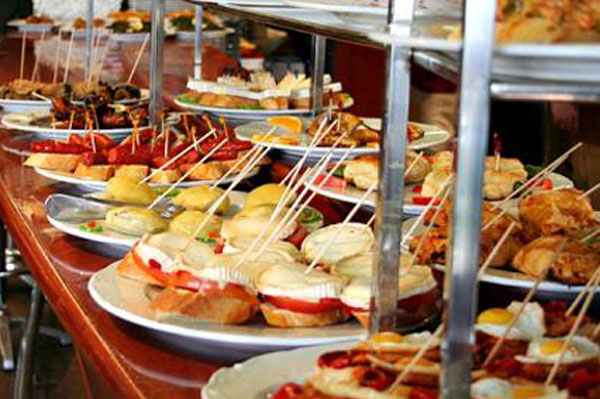 |
| Un bar de pintxos via visitalltheworld.com |
The worst thing I've eaten thus far:
Plain and simple -- Spain's version of delivery pizza blows. Elliot and I happened to stop by a Telepizza on a Tuesday night (when they have half-off specials) and even then it was barely worth it for a medium four-cheese pie.
 |
| The good news is they're hiring -- so Telepizza is plan B. |
How Elliot and I have been passing the time:
We usually have a lot of down time before and after the siesta, which occurs from about 2 to 5 pm. Before the siesta, we probably make some breakfast, hang up some flyers, go for a walk, or watch a little Spanish cable TV. And after the siesta, I'll try my hand at being a writer-for-pay (i.e. writing and submitting drafts to various travel websites) while Elliot busks on a busy street for a couple hours. Keep in mind, this is not how all Spaniards live. Right now, we are just bums trying to find work. But I must say that the siesta allows for much relaxation, as most businesses close their doors during that time of day.
The most embarrassing thing I've done:
The other day I was shopping around for a few things, including a charger for rechargeable batteries. The background for this search involves my camera that requires AA batteries, and me not wanting to buy and throw away batteries all the time. So, I enter an electronics store, looking for this cargador (charger). I notice that they are behind the register, so I explain to the cashier what I need.
"Busco un cagador para pilas."
Translation: I'm looking for a shitter for batteries.
You see, I meant cargador but instead I said cagador so I got a weird look before I corrected myself and proceeded to buy the charger (which was way cheaper than the first place I stopped, so it was still a positive interaction for me).
Something I'm still getting used to:
The double cheek kiss! You've seen it in movies I'm sure. And I usually know it's coming. But some people don't do it upon first meeting, for whatever reason. So when I shake someone's hand, I lean in slightly, awkwardly, and wait until they do the same. And even if they do, I am still surprised. I hope I'm not giving anyone a bad impression. It's just something I'm not good at.
Non-human things I miss:
Along with ginger ale, hamburgers, my (other) bikes, and carrying around more bills than coins, I also miss a little puppy named Pedro! Not to say my parents' other dog Amos or my cat Abby don't matter as much, but I'm constantly reminded of Pedro. What with his latin-influenced name and his likeness to the donkey in the Shrek movies (which I've been watching -- in Spanish).

 |
| Like Pedro, the donkey has a long body, floppy ears, and just loves too much. |
To remind you readers, I'm hoping to use this blog as both a travel journal, and as a log for loved ones to keep track of our expedition. While I hope to update with posts about differences between Spain and the US, comments concerning the European crisis, or discoveries as an English teacher abroad, I also welcome friends and family to use this blog as a venue for your own questions about the Pamplona, Spain, the trip, our experiences, whatever. Even though I'd love to sit down and Skype with every one of you, our busy lives may not allow us that chance. So ask away!
Thursday, July 7, 2011
Baby research
I thought it would be neat to write a post on what my post-graduation job entails. The real one, as opposed the one on the side. (Just kidding)
For some of you, this might be interesting because you're interested in developmental psychology, jobs that resemble careers, babies, etc.
For me, this post not only reflects what I do five days out of the week, but also provides some insight as to what I went to school for in the first place. Especially since I'm currently in the process of paying back my dues.

I am the lab coordinator for the Developmental Science Lab, a psychology research facility, at Temple University. Behind me in the picture to the left, is the lab -- half kindergarten classroom, half high school chemistry lab.
What's more interesting about this picture is that this is what a parent sees when they visit our website and browse the members page. So that's me, trying to look friendly, approachable, and smart! The hand on the hip implies that I'm serious about my job, but I can have fun, too.
Most of my job responsibilities are routine: checking emails, answering phone calls, signing for packages, filing receipts, organizing data, managing undergrad researchers, and stuffing envelopes.
The reason I have this job, though, is more complicated. For those of you not familiar with academic fields that rely heavily on research, research, research, psychology is one of these fields. Most people imagine the whole therapist & couch scenario when they think of psychologists, but most of us (yes, I'm including myself because I've got a fuckin' degree) are researchers. That's how universities get money, and it's also how the field progresses (sort of).
Research, if done right, involves a lot of writing, planning, hypothesizing, and recruiting. Thus, research implicates the contributions of many different people: investigators (tenured professors, grad students, post-docs), interns, student researchers, and volunteers. All these people help to carry out studies, analyze results, and publish anything significant.
In short, my job is to keep all of this going. And the incentive is that if I don't keep all of this going, the lab's projects won't be funded, and I'm out of a job.
Ok, so that was kind of boring. I'll try to talk more about babies.
Yes, my research mainly involves 14-month-old infants! Basically, I invite them and their parents in (usually a mom, but sometimes a dad or a grandma), obtain consent (very important), and then try to put an EEG cap on the child's head.

I wish I could use a picture from our lab, but I'm pretty sure the photo consent form didn't say anything about use on a researcher's blog. This interweb picture does the cap justice, though.
You should know that this process is a challenge. While EEG is used worldwide as a way of collecting data, not many labs attempt to use the technique with children, especially those as young as 14-months.
You can't explain anything to the child about what you're going to do; all you can do is wave the cap in front of them and smile really big so they think it's OK. And it is -- I promise it is.
The first time I put an EEG cap on a baby, she cried. She frowned and buried her head in her mom's chest every time I came near her. I don't know if I can do this, I thought. I'm tormenting her.
But I did do it. And continued to do it. Approximately one out of two babies cry when we put on the cap.
Why? Because it's weird.
They don't want the cap on.
They don't know who I am.
Their mom is almost two feet away.
They haven't had their morning nap.
They have a tummy ache.
Most parents get this -- that babies cry for lots of reasons. Some don't. The mom's face starts to look worried and the baby can sense that and so she wails harder.
I've gotten used to the crying. Not that I don't know the difference between a whine and a get-the-fuck-away-from-me cry. But I'm not going to wince at every whimper.
The more shocking/awkward stuff I see is from the parents:
- One mom consistently bit her son's hand whenever he grabbed for something
- Another chose to start breastfeeding while the study was in session
- There was a dad who lied to me twice about his daughter's age
- A mom who brought four other kids with her, two that weren't hers
- A grandma who left in a huff because she totally disapproved of her daughter and granddaughter participating
- Several parents who disciplined their (14-month-old) son for playing with "girl" toys
Anyway, having worked in this lab for 3 years, I don't think I want to do research.
This job was great; it provided me with invaluable experience. I have sincerely enjoyed it. But seeing the research process in action has discouraged me. There are exceptions, sure, but most studies take at least a few years to plan, carry out, and publish. And it takes far longer for the information learned from these results to trickle down and benefit those concerned.
This bothers me. Especially when I get a rash of calls from parents seeking out an expert who can explain why their child isn't walking, talking, smiling yet. The point of research is to expand resources, but the chain of events is too spread out to be truly effective.
I still maintain that research is an important element for the field of psychology -- still enjoy reading about it. Just don't want to have a role in it. I'm not patient enough.
For some of you, this might be interesting because you're interested in developmental psychology, jobs that resemble careers, babies, etc.
For me, this post not only reflects what I do five days out of the week, but also provides some insight as to what I went to school for in the first place. Especially since I'm currently in the process of paying back my dues.

I am the lab coordinator for the Developmental Science Lab, a psychology research facility, at Temple University. Behind me in the picture to the left, is the lab -- half kindergarten classroom, half high school chemistry lab.
What's more interesting about this picture is that this is what a parent sees when they visit our website and browse the members page. So that's me, trying to look friendly, approachable, and smart! The hand on the hip implies that I'm serious about my job, but I can have fun, too.
Most of my job responsibilities are routine: checking emails, answering phone calls, signing for packages, filing receipts, organizing data, managing undergrad researchers, and stuffing envelopes.
The reason I have this job, though, is more complicated. For those of you not familiar with academic fields that rely heavily on research, research, research, psychology is one of these fields. Most people imagine the whole therapist & couch scenario when they think of psychologists, but most of us (yes, I'm including myself because I've got a fuckin' degree) are researchers. That's how universities get money, and it's also how the field progresses (sort of).
Research, if done right, involves a lot of writing, planning, hypothesizing, and recruiting. Thus, research implicates the contributions of many different people: investigators (tenured professors, grad students, post-docs), interns, student researchers, and volunteers. All these people help to carry out studies, analyze results, and publish anything significant.
In short, my job is to keep all of this going. And the incentive is that if I don't keep all of this going, the lab's projects won't be funded, and I'm out of a job.
Ok, so that was kind of boring. I'll try to talk more about babies.
Yes, my research mainly involves 14-month-old infants! Basically, I invite them and their parents in (usually a mom, but sometimes a dad or a grandma), obtain consent (very important), and then try to put an EEG cap on the child's head.
I wish I could use a picture from our lab, but I'm pretty sure the photo consent form didn't say anything about use on a researcher's blog. This interweb picture does the cap justice, though.
You should know that this process is a challenge. While EEG is used worldwide as a way of collecting data, not many labs attempt to use the technique with children, especially those as young as 14-months.
You can't explain anything to the child about what you're going to do; all you can do is wave the cap in front of them and smile really big so they think it's OK. And it is -- I promise it is.
The first time I put an EEG cap on a baby, she cried. She frowned and buried her head in her mom's chest every time I came near her. I don't know if I can do this, I thought. I'm tormenting her.
But I did do it. And continued to do it. Approximately one out of two babies cry when we put on the cap.
Why? Because it's weird.
They don't want the cap on.
They don't know who I am.
Their mom is almost two feet away.
They haven't had their morning nap.
They have a tummy ache.
Most parents get this -- that babies cry for lots of reasons. Some don't. The mom's face starts to look worried and the baby can sense that and so she wails harder.
I've gotten used to the crying. Not that I don't know the difference between a whine and a get-the-fuck-away-from-me cry. But I'm not going to wince at every whimper.
The more shocking/awkward stuff I see is from the parents:
- One mom consistently bit her son's hand whenever he grabbed for something
- Another chose to start breastfeeding while the study was in session
- There was a dad who lied to me twice about his daughter's age
- A mom who brought four other kids with her, two that weren't hers
- A grandma who left in a huff because she totally disapproved of her daughter and granddaughter participating
- Several parents who disciplined their (14-month-old) son for playing with "girl" toys
Anyway, having worked in this lab for 3 years, I don't think I want to do research.
This job was great; it provided me with invaluable experience. I have sincerely enjoyed it. But seeing the research process in action has discouraged me. There are exceptions, sure, but most studies take at least a few years to plan, carry out, and publish. And it takes far longer for the information learned from these results to trickle down and benefit those concerned.
This bothers me. Especially when I get a rash of calls from parents seeking out an expert who can explain why their child isn't walking, talking, smiling yet. The point of research is to expand resources, but the chain of events is too spread out to be truly effective.
I still maintain that research is an important element for the field of psychology -- still enjoy reading about it. Just don't want to have a role in it. I'm not patient enough.
Subscribe to:
Posts (Atom)